
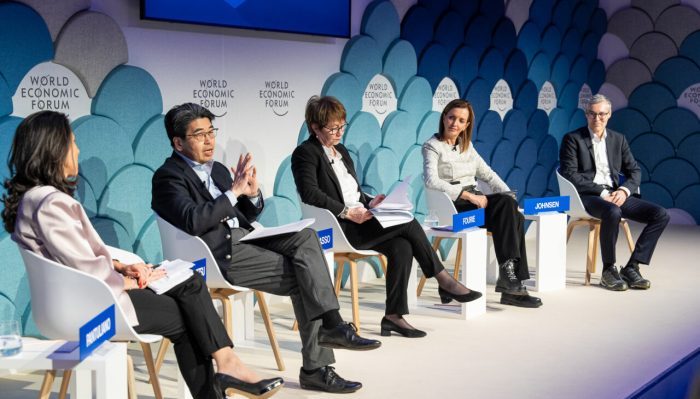
Blended finance is mobilising private investment to meet development aims, but it needs to be part of a wider toolbox of support from national and supra-national bodies, World Economic Forum delegates heard.
Despite reaching a five-year high of $15 billion in 2023—driven by multilateral development banks (MDBs) and development finance institutions (DFIs) tackling climate change and social inequity—this figure pales in comparison to the estimated $4 trillion annual shortfall required to meet global development goals.
A Danish Model for Scaling Blended Finance
Jon Johnsen, CEO of Danish pension fund PKA, highlighted a successful approach taken by Danish pension funds and the government through the Danish SDG Investment Fund. By assuming early-stage risks, the government attracted institutional investors who would otherwise avoid such high-risk projects. The first fund, launched in 2018, is fully invested, while a second fund secured an initial close of €362 million in November 2024.
Johnsen believes this model could be adapted for MDBs to take on first-loss positions, de-risk investments, and scale blended finance solutions.
Beyond Blended Finance: MDBs’ Broader Role
Odile Françoise Renaud-Basso, President of the European Bank for Reconstruction and Development (EBRD), stressed that while blended finance helps unlock private capital, it is too costly to be the primary solution for development financing. MDBs must also focus on:
- Implementing policies to attract large-scale investments
- Strengthening local capital markets
- Addressing currency risks to improve financial stability
- Institutional Collaboration for Development
Hayashi Nobumitsu, Governor of the Japan Bank for International Cooperation (JBIC), emphasized that MDBs and state finance institutions must work beyond investment roles. JBIC collaborates with foreign governments to improve regulatory frameworks and support large-scale projects, such as renewable energy.
However, he warned that assessing risk in blended finance remains complex. For instance, while geothermal energy offers high decarbonization benefits, the uncertainty of energy output before operation makes investment riskier. Risk-sharing mechanisms can help overcome these challenges.
Public-Private Partnerships: A Path Forward
Leila Fourie, CEO of the Johannesburg Stock Exchange, highlighted South Africa’s energy crisis as a catalyst for stronger collaboration between the public and private sectors. Facing unreliable power supply and the need for a renewable transition, stakeholders have built unprecedented cooperation, demonstrating how crises can drive effective partnerships. Blended finance remains a vital tool, but its limitations require MDBs, governments, and private investors to expand their roles in unlocking sustainable and scalable development funding.
Sourced: from an article by Ian Lewis January 2025
 Evenpar Fund