
A safe haven amid stock market volatility
In today’s rapidly shifting economic environment, investors are navigating increasing uncertainty across global financial markets. From inflationary pressures and rising interest rates to geopolitical instability and tech sector corrections, stock markets have become increasingly volatile. In this context, sustainable infrastructure investments have emerged as a compelling, resilient alternative that offers both long-term growth potential and stability.
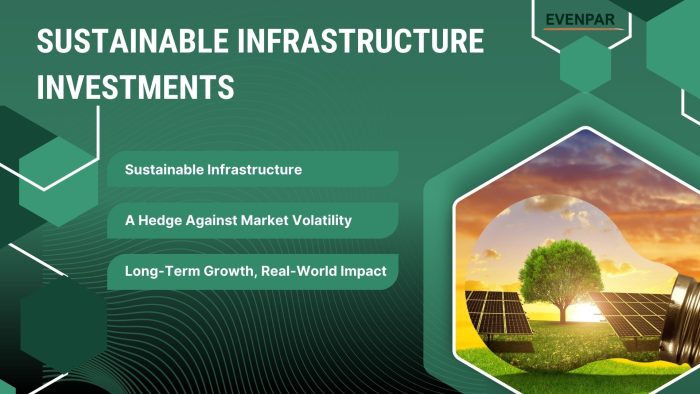
Sustainable Infrastructure
Sustainable infrastructure refers to essential physical systems—such as renewable energy and clean water—designed and operated to minimize environmental impact and maximize social and economic benefits. These projects not only address urgent climate challenges but also generate steady, predictable cash flows over the years, a rare quality in today’s investment landscape (i).
A Hedge Against Market Volatility
One of the most compelling reasons to consider sustainable infrastructure now is its performance during times of market stress. Traditional equities, particularly in technology and speculative sectors, have seen sharp fluctuations in recent years. In contrast, sustainable infrastructure assets—especially those tied to essential services—tend to be less sensitive to market cycles.
BlackRock found that infrastructure assets, particularly those aligned with environmental, social, and governance (ESG) goals, outperformed traditional equities in periods of market volatility. These assets also benefit from inflation-linked revenues (ii).
Long-Term Growth, Real-World Impact
Beyond financial performance, sustainable infrastructure investing offers something many traditional assets cannot: real-world impact. Investing in clean energy, efficient transport, and green urban development contributes directly to the fight against climate change, while also promoting job creation and economic resilience.
Diversification and Institutional Demand
Institutional investors, including pension funds and sovereign wealth funds, are increasingly allocating capital to sustainable infrastructure for its diversification benefits. Unlike public equities, infrastructure assets have low correlation with traditional asset classes, helping investors manage portfolio risk.
PwC’s 2024 Infrastructure Investor Survey showed that over 70% of institutional investors plan to increase allocations to sustainable infrastructure in the next five years, citing long-term yield, ESG alignment, and inflation protection as key drivers (iii).
Conclusion
In a world where economic uncertainty and climate risks are converging, sustainable infrastructure offers a unique investment opportunity—stable, purpose-driven, and poised for growth. With robust policy support, growing institutional demand, and demonstrated resilience in volatile markets, now is the time for investors to look toward the foundations of a sustainable future.
i International Energy Agency, World Energy Investment Report 2024
ii BlackRock Investment Institute, Infrastructure Resilience Report, 2023 PwC
iii Global Infrastructure Investor Survey, 2024
 Evenpar Fund